Evan’s compulsion to commit arson
The Reincarnationist PapersEvan Michaels’s compulsion to commit arson is defined by a paradox: fire first overwhelms him, yet he repeatedly brings it back into his life as a test of whether he has become stronger. In his account, the flame is more than the medium of an act; it becomes a remembered presence, alternately foe, confidant, and constant. That self-description makes arson central to how Evan interprets his past and imagines his capacity to change, without establishing that the compulsion has ended.
First Encounter and the Hearing
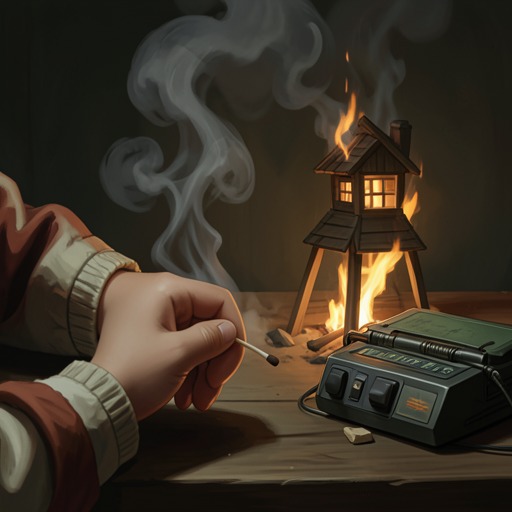
At the hearing, Samas asks Evan not for the details of a particular fire but to speak about fire itself. The distinction shifts the exchange from a record of conduct to Evan’s account of a recurring relationship. Under the panel’s scrutiny, he initially resists Samas’s implication that they both understand the question. He holds Samas’s stare as long as he can, then yields, lights a cigarette, and carefully places the still-burning lighter on the table.
The small flame gives his answer a physical focus. Evan watches its flicker as he describes his first encounter with fire as accidental, and says that he was unprepared for its appetite and anger. It got the better of him then. The account offers no detailed circumstances of that first encounter, but it establishes the imbalance that gives his later repetitions their meaning: at first, fire is something he cannot master.
Repetition, Memory, and Control
Evan says that every encounter after the first has taken place on his own terms. He now knows how fire will act and describes knowing it as well as he knows himself. His return to it is therefore not presented as a simple repetition of the original helplessness. He says he keeps bringing fire back to prove that he can beat it and to show it how he has grown. The act functions, in his telling, as a contest whose terms have changed: the child who cowered under the bed in fear is no longer the only version of himself in the scene.
Yet the contest depends on repetition. Evan must meet fire again to demonstrate that he is different from the frightened child he remembers. The claimed mastery does not erase the original fear; it repeatedly stages that fear in a form he believes he can now confront. His insistence that each later meeting is on his terms sits alongside his need to return, leaving control and compulsion intertwined rather than cleanly separated.
Fire as Adversary and Confidant
Evan’s most striking description turns fire into a witness. He says that he had remembered it and that, until the hearing, it had been the only thing that knew what he was because it remembered him. The wording reverses the usual relation between a person and an object: fire is not merely something Evan remembers doing, but a presence imagined as carrying recognition of him across encounters. In a period he describes as confusion, that imagined continuity made fire his only constant.
The same presence is both hostile and intimate. Evan calls it his foe and his confidant, refusing to settle on one meaning. Its anger and appetite belong to the force that once got the better of him; its constancy belongs to the relationship he says he could rely on when his own identity felt uncertain. This does not make fire a literal companion or establish that it understands him independently. It shows how Evan gives the recurring act a role in his account of recognition, memory, and self-knowledge.
Ability, Desire, and an Unfinished Change
Later, when asked what he might do with a fresh start, Evan says he is unsure what he is good at apart from pyromania. The remark carries the hearing’s account into a different context: what he had described as a chosen test of growth also appears to him as his clearest recognized ability. The label compresses his relationship with fire into a skill, even though his earlier explanation stresses fear, memory, and the need to prove himself.
His companion answers by distinguishing ability from want and asks what Evan wants. Evan replies that he wants to have fun, travel, and enjoy what the world offers. The exchange broadens the question beyond arson: he can name a future desire not defined by fire, even while he has just named pyromania as the thing he knows how to do. The evidence does not say that this wish frees him from the compulsion. Instead, it leaves the change unresolved, placing a desire for experience beside a habit through which he has measured his strength and understood himself.